
How AI can be a freely creative tool
— not just a shortcut
Most coverage of AI focuses on speed and cost. That misses something more interesting: AI removes creative constraints that previously existed purely for economic reasons. Here is what that actually means for small businesses commissioning design work.
The creative constraint AI removes
Traditional design has always been rationed by hours. If a logo exploration costs £80 per direction and your budget is £400, you get five options. If a page layout takes a designer four hours to mock up, you think twice about asking for a second concept. The creative process is squeezed by economics long before it reaches genuinely good ideas.
AI changes this at the iteration layer. We can produce a fully coded, visually complete web page in a fraction of the time it would take manually. That means we can explore three aesthetic directions — editorial, minimal, bold — in the time it would previously take to build one. The client sees real options, not wireframes, and makes a better-informed decision.
AI doesn't replace creative judgement — it removes the penalty for changing your mind. Iteration is now cheap, which means the final result is usually much closer to what the client actually wanted.
Where AI opens up design possibilities
The most powerful applications are not in replacing skilled work — they are in expanding what is possible within a realistic budget.
Visual concept generation
AI image tools can produce photorealistic product photography, brand lifestyle shots, and abstract hero imagery from a text prompt — at zero licensing cost.
Copy and tone of voice
AI drafts page copy, headlines, and meta descriptions at speed. A human editor refines it. The result is better-targeted copy than most small businesses previously had budget to commission.
UI and layout exploration
Entire page sections can be coded and visually styled by AI. Spacing, typography, colour systems, and micro-animations — explored in minutes rather than days.
Rapid refinement
Feedback like "make the hero bolder" or "the colour feels too corporate" translates directly into revised code. Changes that once required a developer are now conversational.
AI in our design process
At Webal, AI is a collaborator with a specific role. It handles the volume and speed of production. We handle the creative brief, the quality filter, and the alignment with your business goals. Every output goes through human review before it reaches you — because AI gets things wrong, and knowing when to override it is a skill in itself.
Brief & aesthetic direction
We define a precise design direction before writing a line of code — sector research, competitor analysis, and a named aesthetic. "Clean and modern" is not a direction.
AI-assisted build
Claude AI generates the HTML, SCSS, and layout structure at pace. We guide every output, reject what doesn't serve the brief, and iterate until it's right.
Human review & refinement
Every page is reviewed against the brief, checked for accessibility compliance, and tested on real devices before being shown to you.
Your feedback, applied fast
Because the build is AI-assisted, your feedback translates into visible changes quickly. What would normally be a week-long revision round takes hours.
See what AI-assisted design looks like for your business
We'll put together a visual direction based on your sector and goals — no commitment required.

Why we build on Joomla
— not WordPress
WordPress runs 45% of the web. That statistic is also exactly why we don't use it. We choose Joomla for every Webal site — and this article explains the reasoning in plain terms, without the hype.
WordPress's popularity is its biggest weakness
When a platform powers nearly half the internet, it becomes the most attractive target for automated attacks. Security researchers consistently find that WordPress sites face a disproportionate share of malware injection, brute-force login attempts, and zero-day plugin exploits — not because the core is poorly written, but because the plugin ecosystem is enormous, under-maintained, and difficult to audit.
The average WordPress site runs 20 to 30 plugins. Each one is a potential attack surface. Plugins conflict, fall out of maintenance, and introduce breaking changes during updates. Many small business owners find themselves locked into paying a developer every few months simply to keep the site running after a WordPress or WooCommerce major version release.
A 2024 Sucuri report found that 97% of all CMS-infected sites were running WordPress. Joomla represented under 1%. This is not a coincidence — it is the direct result of targeted, automated attack tooling built specifically for the WordPress ecosystem.
What Joomla does differently
Joomla's smaller share of the web means it is rarely worth the effort to attack at scale. But beyond target size, Joomla is also architecturally stronger. It ships with a multi-level access control system built in — no plugin required. User groups, viewing access, and editing permissions can all be configured natively, making it genuinely suitable for sites that serve both public content and authenticated member areas.
Built-in access control
Joomla's ACL system handles multi-level user permissions natively. WordPress requires premium plugins to match this functionality.
Gantry 5 framework
Gantry gives us a layout system, SCSS pipeline, and particle architecture that produces far leaner front-end output than any WordPress page builder.
Stable update cycle
Joomla updates are less frequent and better tested. Plugin compatibility is managed centrally, removing the maintenance avalanche WordPress owners know well.
Less plugin dependency
Core features like categories, custom fields, and contact forms are built in. We rarely need third-party plugins, reducing cost and attack surface together.
Faster sites, lower long-term cost
WordPress page builders — Elementor, Divi, WPBakery — output bloated HTML full of inline styles, unused JavaScript, and nested wrapper divs. The results are sites that look fine in the editor but score poorly on Core Web Vitals. Every percentage point of performance is a ranking signal and a conversion driver; builder-generated WordPress sites regularly need expensive speed optimisation work just to reach acceptable scores.
A Webal Joomla site built on Gantry 5 outputs clean, semantic HTML. Our SCSS compiles to a single stylesheet. There are no jQuery plugins loading on every page. Scores in the 90s on PageSpeed Insights are the norm, not the target.
WordPress premium plugins typically cost £50–£200 per year each — and most sites need several. A Joomla build has no equivalent ongoing plugin licence costs. Over three years, the difference is often more than the original build fee.
Ready for a website that works as hard as you do?
Every Webal site is built on Joomla — secure, fast, and designed to last. Get a no-obligation quote today.
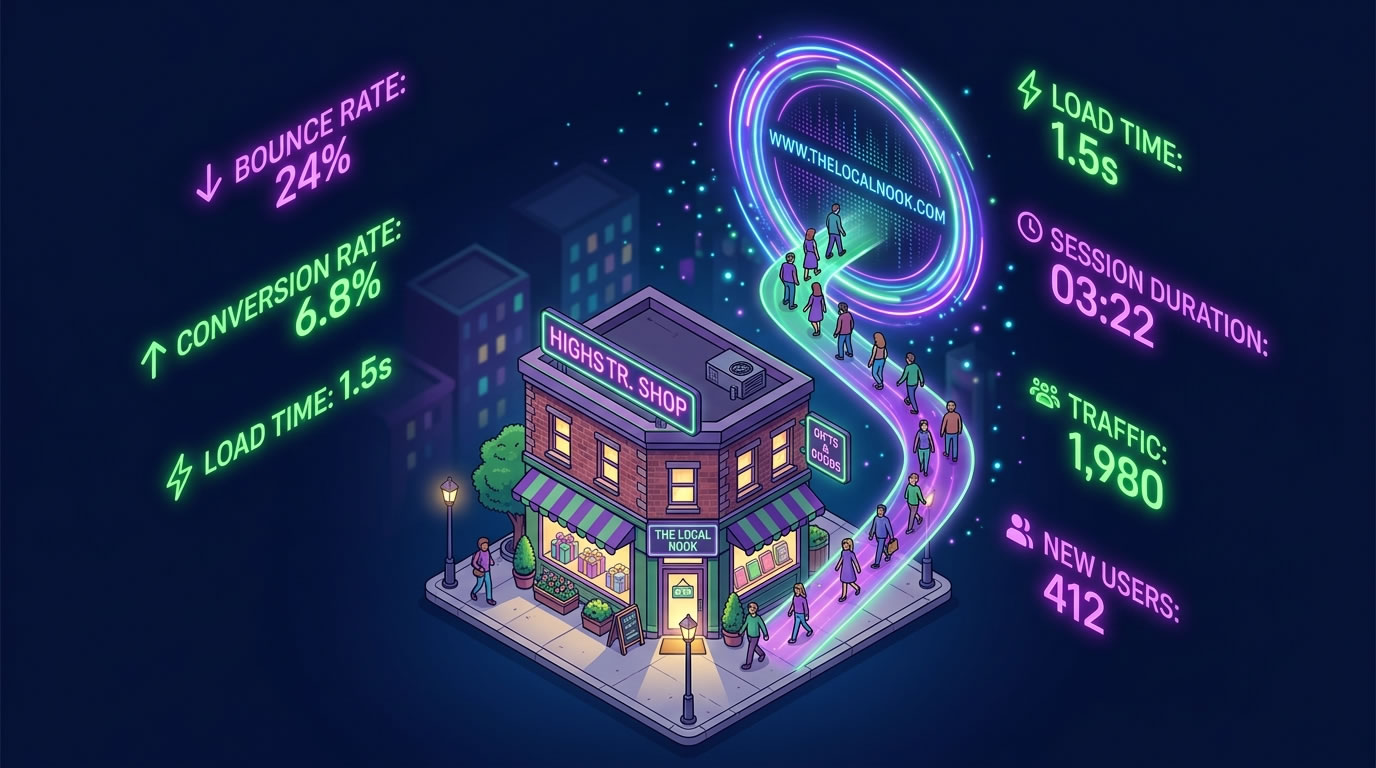
What percentage of engagement
does your website actually drive —
and what should it include?
For most small businesses, the website is the single highest-leverage marketing asset they own. But many are either not tracking engagement at all, or building pages that actively lose customers. Here is what the data says, and what to do about it.
Your website works harder than any member of staff
A small business website is open 24 hours a day, fielding enquiries from people who have never met you and are deciding within seconds whether you are credible enough to contact. Research from Stanford's Web Credibility Project found that 75% of users make credibility judgements based on a site's visual design alone — before reading a single word of copy.
For local service businesses — trades, consultants, clinics, retailers — the website is often the final decision point between a customer choosing you or a competitor. Google Business and social media bring traffic, but the website is where that traffic converts to an enquiry, a booking, or a purchase.
The average small business website converts between 1% and 3% of visitors. Well-structured sites with clear trust signals and fast load times routinely achieve 5–8%. The difference is not traffic — it is the page itself.
What every small business website needs
The best-performing small business sites share a consistent set of elements. These are not design trends — they are conversion fundamentals backed by years of A/B testing data.
A clear value proposition
Visitors need to know what you do, who you do it for, and why you are the right choice — in under five seconds. If your headline is your company name, you are losing people.
Social proof above the fold
Star ratings, review counts, or a single powerful testimonial placed in the hero section increases contact rate significantly. People trust other customers more than they trust your copy.
One primary call to action
Every page needs a single, prominent next step. "Get a free quote", "Book a call", "Shop now" — not all three simultaneously. Choice paralysis kills conversions.
Local trust signals
For local businesses, showing your town, county, or region — combined with a recognisable accreditation logo or award — increases contact rates from local search traffic measurably.
Speed — genuinely fast
Google's own data shows 53% of mobile users abandon a page that takes more than 3 seconds to load. Speed is not a technical nice-to-have — it is a direct revenue driver.
Frictionless navigation
Users should be able to find your services, pricing indication, and contact details within two clicks from any page. Complex menus and buried contact forms lose enquiries.
Engagement is designed in, not added on
The common mistake is treating engagement as a problem to solve after launch — adding a popup here, tweaking a button colour there. The sites that perform well from day one are those where the conversion journey is considered at the design stage, not retrofitted afterwards.
A well-designed homepage should answer three questions in order: Can you solve my problem? Are you credible? How do I contact you? Every section of the page should serve one of those three questions. If it doesn't, it shouldn't be there.
Is your website working hard enough?
We audit, redesign, and rebuild small business sites that are built to convert — not just look good. Talk to us about what yours could be doing better.